Instagram: @hectorfmunoz
Bio: Bio After completing his foundation year at Parsons School of Design and studying painting at the Rhode Island School of Design, Hector paused his formal education due to a bipolar diagnosis and financial hardship. He continued to work outside institutional settings, developing his practice and exhibiting locally. His first solo exhibition, Tocando Tierra, was presented at Room 3557 Gallery (Los Angeles). Selected group exhibitions include Marin MOCA (Marin), Berkeley Historical Society Museum (Berkeley), Personal Space (Vallejo), Charlie James Gallery (Los Angeles), Watts Towers Art Center (Los Angeles), Bureau Gallery (New York), Good Mother Studios (Oakland), Pt. 2 Gallery (Oakland), and the RISD Museum (Providence, RI). Hector published the artist book Brown Eyes from Russell Street with Sming Sming Books, now archived in the San Francisco Museum of Modern Art’s Research Library. His work has been featured in 48 Hills, Berkeley Times, Overstandard, Juxtapoz, Mousse Magazine, and New American Paintings. He was a finalist for the Headlands Center for the Arts Tournesol Award and nominated for the SFMOMA SECA Award in 2023. In 2024, Hector entered the Master of Fine Arts program at the University of California, Berkeley, where he is currently in his second year. He is also a facilitator at Creative Growth Art Center and is based in Oakland, California.
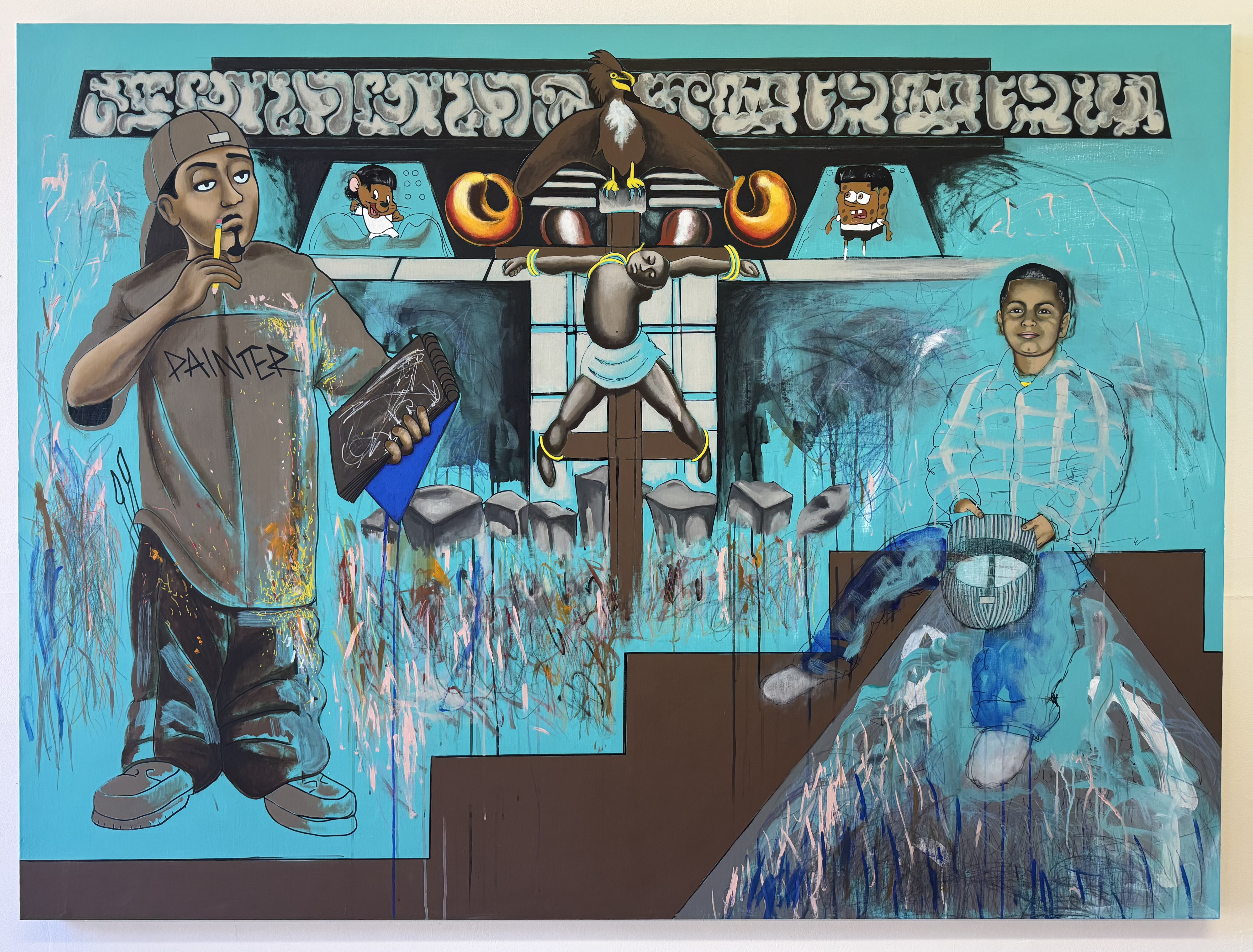
Statement: Artist Statement Héctor Muñoz-Guzmán (b. 1999) is a disabled, first-generation Chicano painter from South Berkeley, California, born and raised in the Bay Area. His work is rooted in the stories of working-class Mexican American communities, particularly those in the Bay Area, whose lives are rarely represented in contemporary art spaces. Muñoz-Guzmán’s paintings and mixed-media works draw from both personal and collective histories, merging lived experience with broader Chicano and Mexican artistic traditions. Beginning with intimate collages composed of family photographs, Mesoamerican/Catholic imagery, and found materials, he builds complex compositions that layer memory, heritage, and place. What began as a resourceful approach to art-making—due to limited access to traditional supplies—has evolved into a defining element of his practice. His materials, surfaces, and subject matter honor his family’s history and the communities that shaped him. His use of saturated color reflects the vibrancy of his South Berkeley upbringing as well as the warmth of his family’s ancestral home in Tepatitlán, Jalisco, Mexico. The work carries a matter-of-fact directness akin to social realism while embracing tenderness and care for its subjects, whether they depict community gatherings, agricultural labor, or states of mind shaped by depression and resilience. His life journey deeply informs Muñoz-Guzmán’s visual language.
 Héctor Muñoz-Guzmán | 120710 -