How to bid on a piece at auction
What bidding looks like, what you see, and what happens if you win.
-
Auctioned work says so on its page, with the current bid and how many bids there have been. There is no Buy button while an auction is running — the bidding is how it sells.
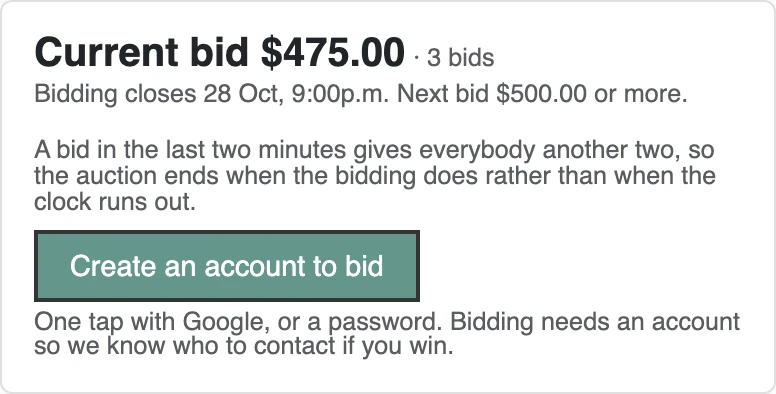
- Bidding opens at the preview and closes at the end of the closing reception.
-
You need an account to bid, so we know who to contact if you win. One tap with Google, or an email and password. Making an account does not make you an artist and does not put you on any public page.

-
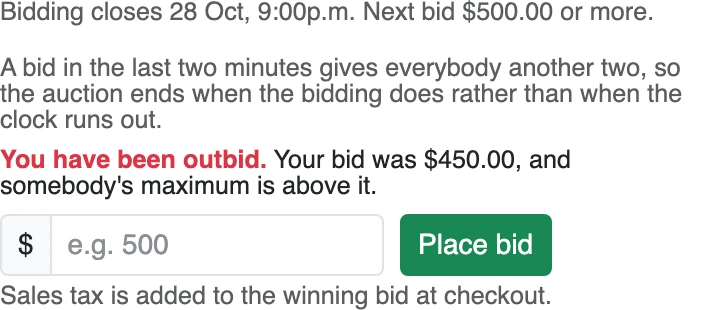
The first bid only has to meet the minimum. After that each bid climbs by a step — $25 up to $500, $100 up to $2,000, and so on — and the page tells you what the next bid has to reach. You can bid more than that; you cannot bid less. Type your figure into the box — the greyed-out “e.g.” amount is an example, not something already entered — and press Place bid.
-
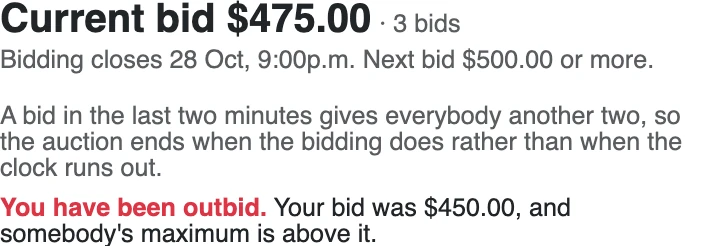
Once you have bid, the page tells you where you stand: “You are the highest bidder” or “You have been outbid”, kept up to date as the figure moves, without reloading.
-
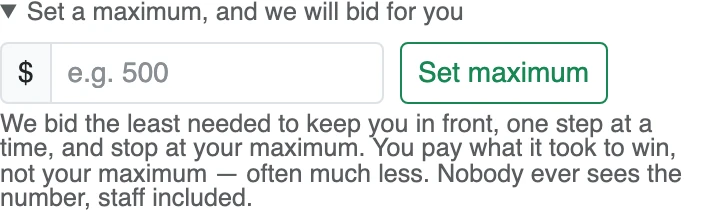
If you cannot watch it, set a maximum — “Set a maximum, and we will bid for you”, under the bid box. Say the most you are willing to pay and we bid the least needed to keep you in front, one step at a time, stopping at your figure. You pay what it took to win, not your maximum — often much less. Nobody ever sees the number — not the other bidders, not the artist, not the gallery — because knowing what somebody will pay is worth more to the other side than knowing what they have already bid. You can raise it at any time, and raising it does not raise the price.
- We do email you when you lose the lead, with where it is now and what the next bid has to reach. Not every time somebody bids — a busy few minutes at a closing reception would be several mails about prices that were already beaten before any of them arrived — so there is a gap of ten minutes between them, and none at all once bidding has closed, where the result is the better mail. If your maximum is what was passed, it says so: that is a decision rather than a click.
- The mail never says who outbid you, or whether it was somebody’s maximum that did it. The second would tell you there is headroom above the figure, which is exactly what a maximum is for not telling you.
- A bid in the last two minutes gives everybody another two minutes, and again, until two minutes pass with nobody bidding. So the auction ends when the bidding ends, not when a clock runs out — nobody wins by refreshing at exactly the right second.
- Nobody ever sees who bid or what they bid. Not the public, not the artist, not other bidders.
- If you win you get an email with a link, and the piece is held for you for 24 hours. Follow the link and pay — no account needed at that point, and if a card is declined you can simply try again. California sales tax is added to your bid at the payment screen, which is the one figure that is larger than the number you bid. Most winners are standing in the gallery and pay before they leave.
- If you do not win you hear once, at the end: that the piece sold, or that nobody completed the purchase and it is now on sale at the artist’s minimum.